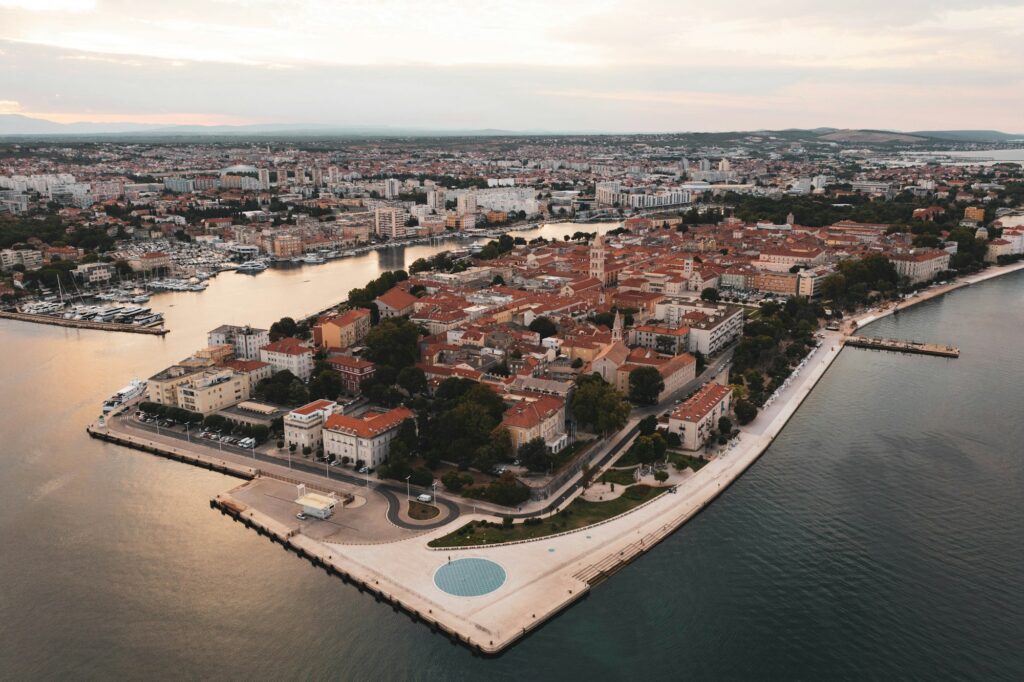
Zadar is the day trip that surprises people. An hour and a half north of Split, it has the Roman bones and marble streets you’d expect — and then two modern installations on its seafront that turn an ordinary evening into something you remember. It’s an easy, rewarding day if you time it for the light.
The Sea Organ — the city’s best idea
On the tip of Zadar’s peninsula, a set of broad white steps drops into the sea — and as waves push air through pipes hidden beneath, the whole thing hums and sighs in slow, tuneless chords. It’s the Sea Organ (Morske orgulje), and you don’t watch it so much as sit on the warm stone and listen while the Adriatic plays. It’s free, it’s always on, and it’s the most quietly magical spot on the coast.
The Greeting to the Sun, and that sunset
Right beside it, a large disc of solar panels set into the pavement soaks up the day and lights up after dark in shifting colours — the Greeting to the Sun (Pozdrav suncu), best after the sky goes down. And the sky here is the point: Alfred Hitchcock famously called Zadar’s sunset the most beautiful in the world. Sit on the Sea Organ steps as the sun drops behind the islands and you’ll understand the fuss.
The old town: Roman forum and a round church
By day, Zadar’s compact peninsula is a pleasure to wander. The Roman Forum still lies open in the middle of town, and beside it stands St Donatus, a huge round 9th-century church built partly from recycled Roman stone. Add the cathedral bell tower for a view, a few marble lanes, and a cone of Zadar’s famous maraschino-cherry liqueur, and the daytime fills itself easily.
Getting there
It’s about 1.5 hours each way. Frequent buses run from Split’s main bus station, and driving the A1 motorway is quick and simple — see our transport guide for the lay of the roads. With a car you can fold in a stop on the way; by bus, go direct and keep it simple.
The timing tension (and how to solve it)
Here’s the honest catch: Zadar is at its best at sunset, but a day trip wants you home for dinner. The fix is to lean into the evening — arrive mid-afternoon, do the old town in the cooler hours, then stay for the Sea Organ and sunset and take a later bus or drive back in the dark. If you’d rather not do a long evening, go in the morning and accept you’re seeing the daytime version. Both work; just choose on purpose.
Make it two stops
With a car, Zadar pairs beautifully with a stop on the way: the Plitvice or Krka direction, or the little Roman town of Nin with its lagoon and tiny church. It’s also a gentler, less-touristed alternative to chasing Dubrovnik all the way south. For the full menu of where a day from Split can take you, see our day-trips guide — then come back to the old town with the sound of the sea still in your head.