Most travel guides treat “getting to Split” as a one-line footnote. That’s fine if you’re flying in from London for a long weekend. Less fine if you’re driving from Vienna with a car full of kids, or coming off the Ancona ferry at 7am with no clear plan for the next twelve hours. This is the practical version — the seven realistic ways into Split, what each one actually costs you in time, and the small details locals know that the booking sites don’t tell you.
Flying into Split Airport (SPU)
The main door. Split Airport sits twenty kilometres northwest of the city, near Kaštela. Direct seasonal flights from May to October from most European hubs — Vienna, Munich, Frankfurt, Berlin, London, Amsterdam, Paris, Milan, Rome, Stockholm, Warsaw, Madrid. Off-season (November to April), the network thins down to mostly Croatia Airlines connections via Zagreb plus a handful of low-cost routes from London and Frankfurt.
From the airport, you have four options: the public bus (Promet line 37, €4, runs every 20 minutes, about an hour to the centre), the Pleso airport shuttle (€8, faster, drops at Split bus station), a taxi (~€35-45 to old town, fixed prices posted on a board outside arrivals), or a pre-booked transfer (€50-60 for a private car, worth it if you arrive after 11pm). Full airport guide here with current schedules and the best pickup spot.
Ferries from Italy
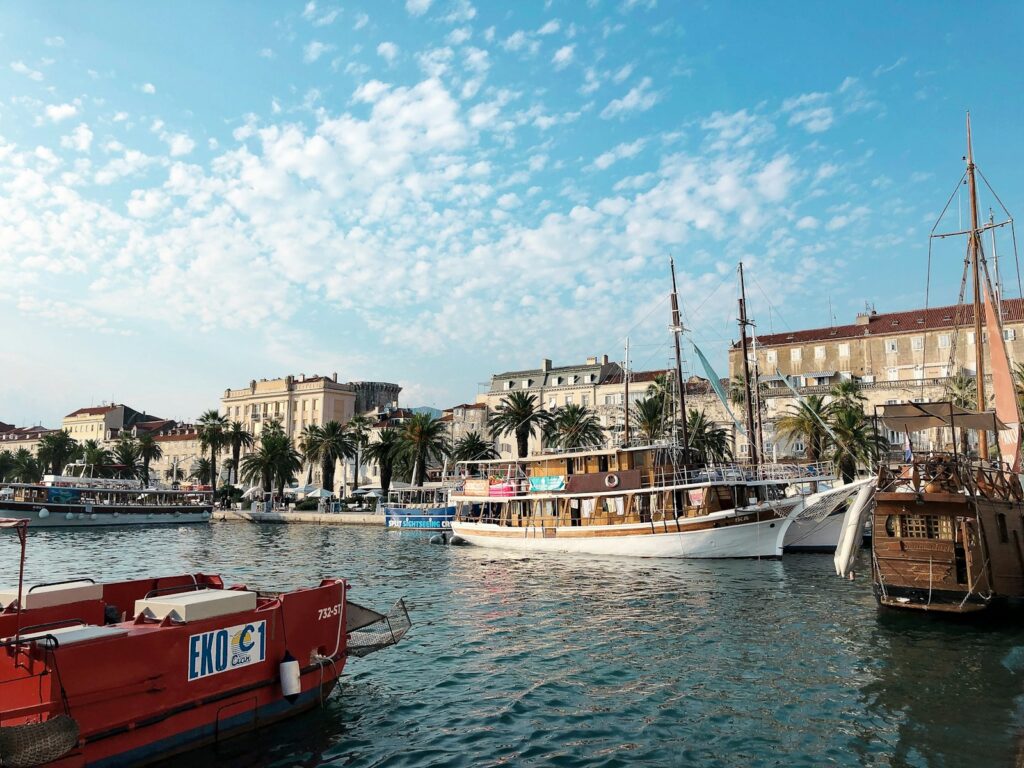
The slow, beautiful arrival. Two operators run overnight ferries from Italy to Split: Jadrolinija from Ancona (year-round, daily in summer, every other day in winter — €60-90 per person plus extra for a cabin) and SNAV from Ancona (summer only, faster catamaran-style, €70 one-way). Both arrive at Split’s main port directly in front of the Riva, a five-minute walk from Diocletian’s Palace.
The Ancona ferry is the romantic option — sleep through the Adriatic, wake up to Split’s bell tower on the horizon. The Jadrolinija boats are old but comfortable; book the smallest cabin if you can. Bring your own coffee for the morning.
Driving from Vienna, Munich, or Budapest
Eight to ten hours from any of the three, mostly highway. From Vienna you go through Slovenia and Zagreb — about 950 km, eight hours of driving plus border stops. From Munich it’s similar mileage through Salzburg and Ljubljana. From Budapest, slightly faster (~7 hours) via Zagreb.
The whole route is paid highway — A1 from Zagreb to Split costs around €30 in tolls (electronic ENC tags work too, faster at booths). Croatian highways are excellent, well-signed, and rest stops are frequent. The stretch south of Zadar opens up into the most dramatic coast scenery you’ve seen from a car window. Don’t drive it tired — Senj to Split is winding even on the highway.
Driving from Milan or Northern Italy
Two routes: the short one (Milan → Venice → Trieste → Rijeka → Split, about 10 hours, all coast highway after Trieste) or the long one (Milan → Bologna → Ancona → Ferry to Split, two-day trip but you skip 700 km of driving). For most travellers with one driver, the ferry option is more relaxing despite costing more.
Bus from Zagreb, Belgrade, or Sarajevo
Long-distance buses still serve Split heavily. Zagreb to Split takes five to six hours (€20-35, FlixBus and Croatia Bus both run multiple times daily). Belgrade is ~12 hours via Sarajevo and back through Bosnia, scenic but slow. The Split bus station sits right next to the ferry port — ten minutes on foot from the old town. Buses are clean, on time, and have Wi-Fi.
Train from Zagreb (and why we don’t recommend it)
There is a Zagreb-Split train. It exists. It takes seven and a half hours — slower than the bus and roughly the same price. The route is scenic in places but the carriages are old and there’s no dining car. The bus is the better choice unless you specifically love trains.
Parking in Split’s old town (the unspoken hard part)
If you drive in, expect the last mile to be the hardest. Split’s old town is car-free — Diocletian’s Palace is a UNESCO pedestrian zone. Public lots ring the centre: Tržnica (just east of the palace, €2-3/hour, often full from 9am), Sukoišan (west, larger, often available), and Bačvice (south, near the beach). For a week-long stay we recommend leaving the car at one of the long-stay lots near the bus station (€15-20/day) and walking.
Our guests at all four apartments get a current parking guide on check-in — we know which lots are full when, and where the cheap weekly options are. The Solin apartment has free parking right at the building, which solves the problem entirely if you’re car-dependent.
The honest summary
Fly into Split Airport for speed. Take the Ancona ferry for romance. Drive from Central Europe if you’ve already got a car full of luggage and kids. Don’t take the train. Park outside the walls. Whichever way you arrive, the last ten minutes of the trip — walking through the marble streets of Diocletian’s Palace toward your apartment — is the part that makes everything worth it.
Once you’ve decided how you’re getting here, plan what to bring. See our honest Croatia packing list — what locals actually carry vs. what the internet recommends.