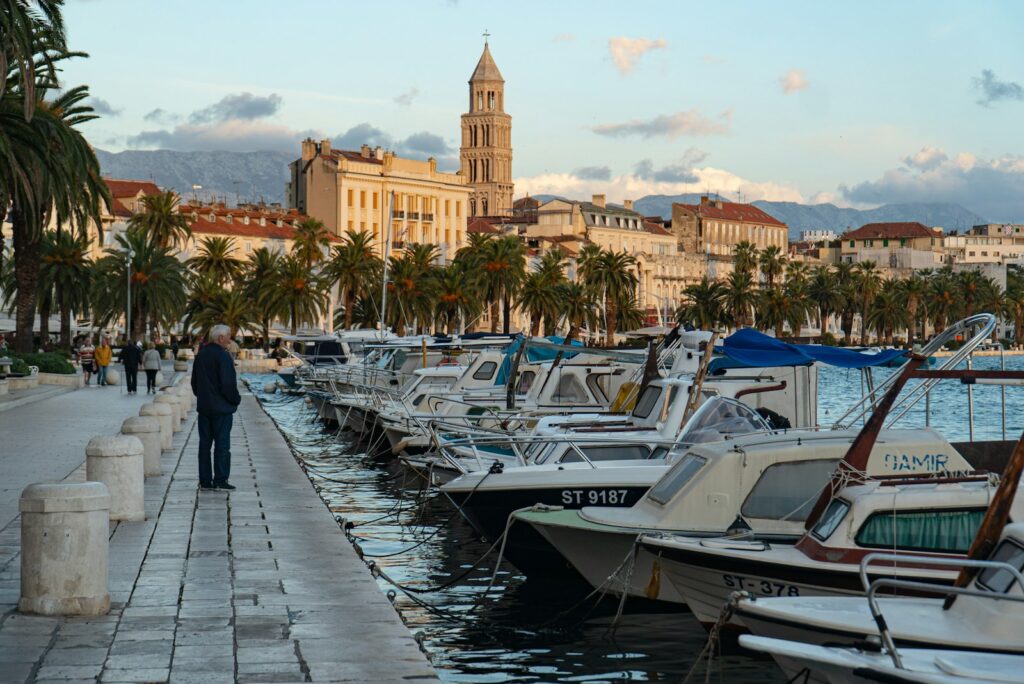
The best drink with a sea view in Split is not on a terrace at all: it is on the stone edge at Matejuška, the small fishermen’s harbour at the western end of the Riva, with a bottle bought from a shop and your feet over the water. If you want a table and a waiter, the Riva’s palm-shaded cafés look straight down the harbour, the Vidilica terrace at the top of the Marjan steps puts the whole old town beneath you, and the west-facing coast catches the last of the light. This is a city that drinks slowly and outdoors, and it does not need a rooftop to do it.
Matejuška: the stone edge
Every local has sat here. Matejuška is a working harbour of small wooden boats, and its breakwater has become Split’s unofficial living room around sunset — students, fishermen, couples, someone with a guitar, everyone facing west. The ritual is simple: buy something cold at a shop, find a spot on the stone, and stay until the light goes. Nobody will hurry you and nothing costs what a terrace costs. Take your bottle and your rubbish home with you; that is the whole etiquette.
The Riva, for the passeggiata
The Riva is the palm-lined promenade along the harbour, and its cafés are where Split does the early-evening pass — coffee that turns into a spritz, the same slow lap of people you saw yesterday. Sit facing the water in the late afternoon and you get the boats, the islands going blue, and the bell tower behind you catching the last sun. It is touristy in the honest sense: locals are also there, because it is genuinely the best seat in town. Come at seven, not at ten.
Vidilica: the terrace above the roofs
Climb the stone stairway from Veli Varoš up towards Marjan and you reach Vidilica — a café terrace on the hillside with the whole old town, the harbour and the islands laid out below. It is ten sweaty minutes up from our door and it repays every step, especially in the hour before sunset when the roofs turn orange. Order something small and stay a long time. From here you can carry on into the pines if you want the Marjan walk instead of a second round.
The west-facing coast
Sunset in Split happens on the western side. The Zapadna obala promenade, past the ferry port, gives you an unfussy stretch of waterfront with the light straight in your face; further round, under Marjan, the pine-backed cove at Kašjuni has a beach bar and a swim before your drink, which is the correct order. This is the practical answer to where locals watch the sunset — and if you want to follow the light on foot rather than sit still, our golden hour walk maps the same hour.
What to actually order
The default is a spritz — white wine and mineral water, called gemišt, the drink that makes a Dalmatian afternoon last. In summer, bevanda (red wine with water) is the honest local order, and for something sharper there is rakija, which is not an aperitif so much as a punctuation mark. If you would rather drink properly, ask for a glass of Plavac Mali or a Pošip; our wine map explains what to look for. Coffee is also a legitimate sunset drink here — see Split for coffee people.
The unwritten rules
Drinks here are slow. One glass can hold a table for two hours and no one minds; hurrying is the only bad manners. Rooftop bars exist above the old town and they are pleasant, but they are not where the city goes — the city goes to the water. Dress is whatever you swam in. And the good hour is not sunset itself but the twenty minutes after it, when the crowd thins, the stone gives back its heat and the islands go the colour of a bruise.
Doing it from the door
All of this is walkable from Veli Varoš. From our apartments it is about five minutes down to Matejuška, ten along to the Riva, and the same stairway that leads to Vidilica starts at the end of the street. That is the real argument for staying in the old quarter: the whole evening happens without a car, a taxi or a plan.