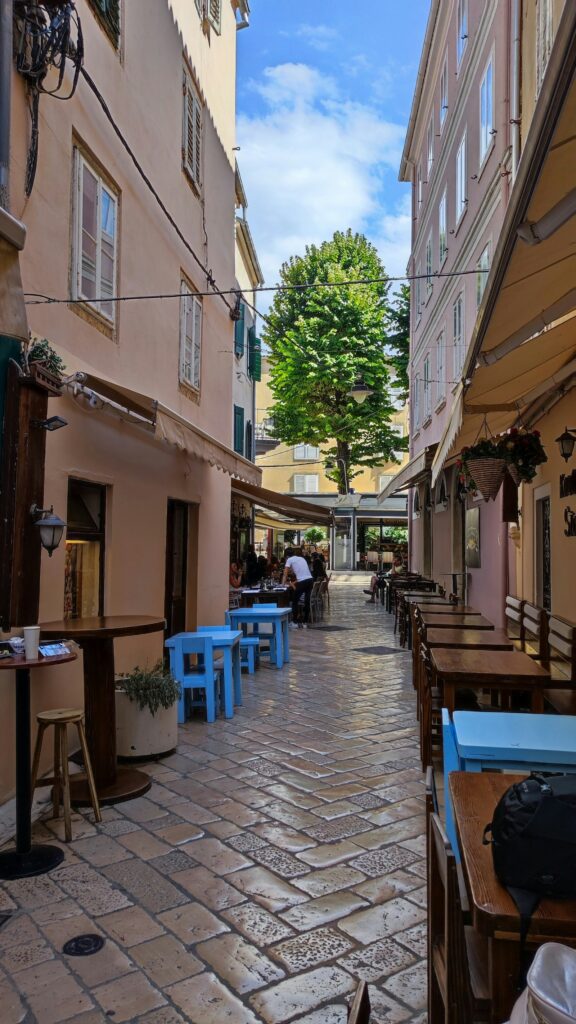
If you come to Split expecting a quick espresso shot the way Italians do it, you’ll be lost in the first ten minutes. Coffee in Croatia isn’t a beverage. It’s an excuse to sit down for an hour, ignore your phone, watch the street, and talk to whoever shows up. Locals don’t go for coffee; they go for kava. The drink is incidental. The sitting is the point.
“Idemo na kavu” doesn’t mean what it says
Translated literally, idemo na kavu means “let’s go for a coffee.” In practice it means “let’s hang out for an hour or two and we’ll figure out the rest as we go.” If a Croatian friend says it, you’re not making plans for ten minutes; you’re making plans for the afternoon. The drink itself can be ordered, abandoned, refilled, never finished. Nobody is keeping score.
What to actually order
Forget cappuccino — it’s there if you want it, but it’s a tourist tell. The locally beloved drink is the macchiato (pronounced ma-kee-AH-to here, just like the Italian) — a strong espresso with a small splash of milk. Other staples:
- Espresso — the default if you say “kava”.
- Bijela kava — “white coffee”, essentially a small latte. Standard morning order.
- Kava s šlagom — coffee with whipped cream, ordered shamelessly by older men in winter.
- Espresso s mlikom — espresso with a side of cold milk you pour yourself. Power-user move.
Prices for a sit-down coffee on the Riva range €2.50–€4. On a side street, €1.80–€2.50. Nobody charges you for sitting; the table is yours as long as the cup is on it.
Where to actually go — leave the Riva
The Riva (waterfront) cafés have the view, the price tag, and the cruise-passenger crowd. They’re fine for one drink. The good coffee — and the good people-watching — happens one block off the promenade:
- The narrow alleys around Pjaca (People’s Square) — tiny terraces wedged into Diocletian’s Palace walls.
- Matejuška, the old fishermen’s harbour just west of the Riva — concrete benches, sailors, cheap drinks.
- Bačvice promenade — the row of pavilion cafés overlooking the city beach. Best at dusk.
Specialty coffee — yes, even here
Split has a small but excellent third-wave coffee scene. Kap Coffee Roasters is the local favourite — they roast their own beans, the baristas know origin and tasting notes, and you can order things that don’t appear on a Croatian café’s menu (filter, batch brew, even cold-brew tonic). Several other independent roasteries have opened in the past few years. If you care about beans, you have options.
Coffee with a view
Three options for the “this is what I came to Croatia for” coffee moment:
- Café Žbirac, Bačvice — directly above the city beach, full Adriatic on the horizon.
- Marjan Hill — first plateau café — twenty-minute walk up; Split’s old town spread below.
- Top of the Cathedral bell tower — you can’t drink coffee up there, but climb it before you sit down anywhere; everything else makes more sense after.
The unwritten rules
Three things foreigners get wrong:
- Don’t take it to-go. Paper cups exist, but ordering one marks you instantly as a non-local. Sit down. Even if you have ten minutes.
- Don’t tip 20%. Round up to the nearest euro, or leave the small change. €2.30 → €3 is generous. A 20% tip is American and unnecessary.
- Don’t ask for the bill until you’re ready to leave. Servers will not interrupt your hour. You signal when ready (“račun, molim”).
Where to stay if you want to make this a habit
Coffee culture is hard to do from a hotel room. The whole point is to walk three minutes from your front door, settle into a side-street café, and watch Split wake up. Our three apartments at Ćiril-Metodova 36 are three blocks from Pjaca and the best alley terraces; the Riva and Bačvice are both ten-minute walks. The Solin apartment swaps city café culture for the quieter village version — same rhythm, fewer tourists.
The fastest way to feel less like a tourist in Split is to order a macchiato, sit for an hour, and not look at your phone. Try it tomorrow morning. The city changes shape.