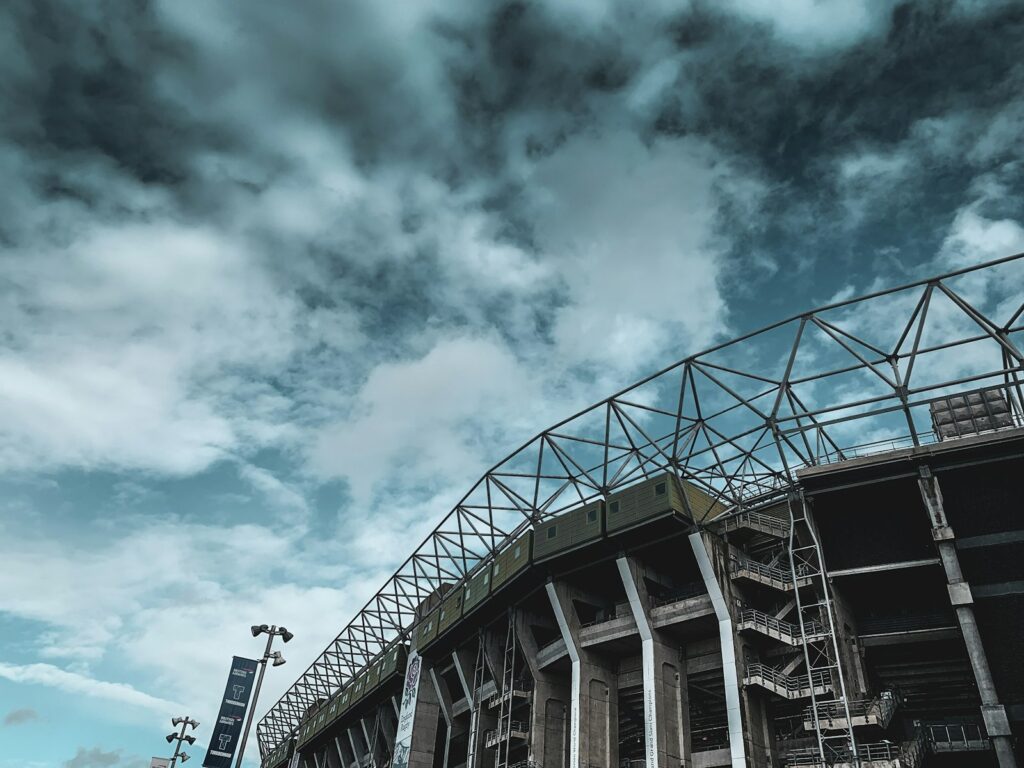
You can absolutely go to a Hajduk match as a visitor, and for most league games you can get a ticket without planning ahead — check the club’s site for the fixture and buy online or at the stadium. What you get for it is the single most concentrated hour of Split there is: thirty-odd thousand people in a concrete shell by the sea, a north stand that does not sit down, and a kind of noise the city produces nowhere else. It is not a polished tourist experience and it is not trying to be. That is precisely the point.
The club, briefly
Hajduk was founded in 1911 — not in Split, but in Prague, by a group of students from Split who settled on the name in a pub there and brought it home. The team plays in white and is known simply as Bili, the whites. For a city of this size the club is disproportionately central: it predates most of what people come here to photograph in terms of civic importance, and it has survived every change of state, flag and currency this coast has been through. Support is not a hobby here; it is inherited.
Poljud itself
The stadium is worth seeing even without a match. Opened in 1979 for the Mediterranean Games and designed by Boris Magaš, Poljud is a long white shell — two great curved roofs meeting over the stands like a scallop opening — and it is genuinely admired as architecture, which is not something one says about many stadiums. It sits north-west of the centre, close enough to walk to in about half an hour or reach on a local bus; our guide to getting around without a car covers the buses.
Torcida
The north stand belongs to Torcida, founded in 1950 and named after the Brazilian torcedores that Split students had seen at that year’s World Cup — which makes it the oldest organised supporters’ group in Europe. They stand for ninety minutes, they run the chanting, and on big nights the stand disappears entirely behind flags and smoke. Watching Torcida is, for a lot of visitors, more interesting than watching the football. It is also loud in a way that is hard to convey in writing.
Which seat to buy
This is the practical decision. The north stand is Torcida: standing, singing, flares, and not where you want to take a seven-year-old or a camera you care about. The east and west stands are where families and older fans sit — you see the whole pitch, you hear everything, and you can leave when you like. For a first visit, take the west or east side and look across at the north. You will still feel it.
The honest warnings
Flares get lit, and when they do a section of the stadium fills with smoke that catches in the throat; if that is a problem for you, sit high and to the side. It is loud enough that small children often hate it. Language in the chanting is what it is. And the derby against Dinamo Zagreb — the vječni derbi — is a different proposition entirely: harder to get into, far more intense, and not the game to choose for a gentle introduction. Pick an ordinary league Saturday instead.
Making a day of it
Do what locals do and build the afternoon around it rather than just turning up. A long lunch first — our guide to what to eat in Dalmatia is a decent menu — then the walk out to Poljud with the crowd thickening as you go, then back into town afterwards while the whole city is still discussing it. The evening after a home win is one of the better times to be in Split; our evening guide covers where it goes.
Why a visitor should care
Because Split in summer can feel like it is performing for you, and this is the opposite. Nobody at Poljud is there for your benefit. It is the city doing something entirely for itself, at full volume, and you are welcome to stand in it. If fjaka is one half of the Dalmatian temperament, this is the other half — and you cannot really claim to have seen the place having met only the quiet one.
Getting there from the old town
From our apartments in Veli Varoš it is a walk of roughly half an hour along the water and up, or a short bus ride. Go early, follow the white shirts, and do not drive — parking near the ground on a matchday is exactly as bad as you would expect.