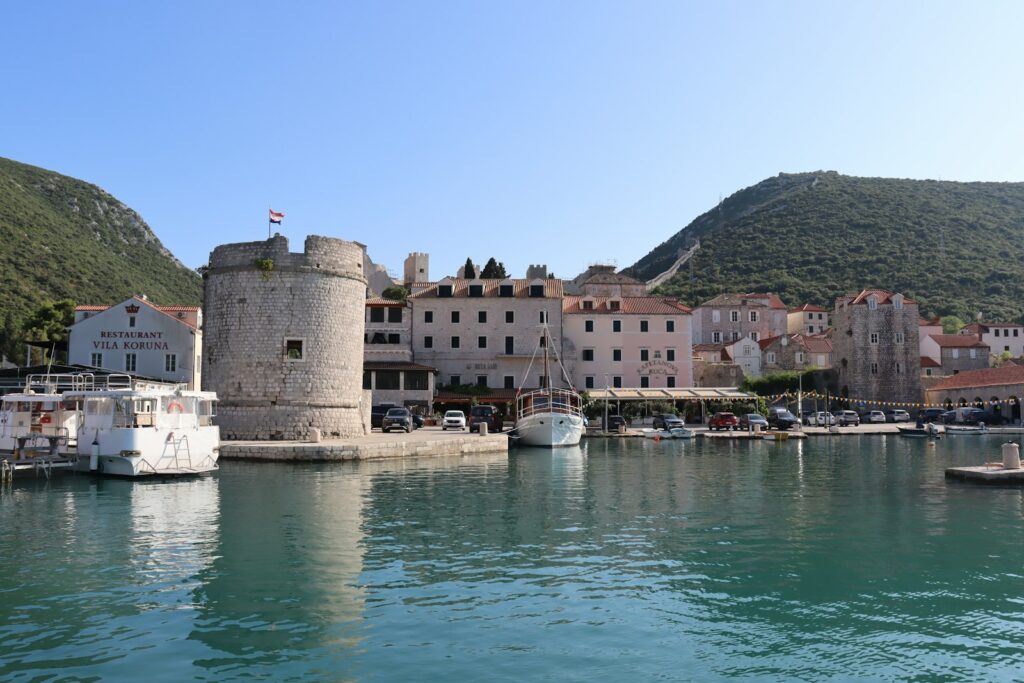
You can do Ston and the Pelješac peninsula from Split in a day, and it is worth it — but be honest with yourself first: it is about two to two and a half hours each way, which makes it the longest day trip we recommend. Since the Pelješac Bridge opened you drive straight there without crossing a border. What you get for the distance is unusual: the longest defensive walls in Europe, salt pans still raked by hand after seven centuries, oysters pulled out of the bay in front of you, and the steep vineyards that produce Croatia’s most famous red. Leave early and treat it as a full day.
The drive, and why it changed
Head south on the A1, come down to the coast near Ploče, and cross the Pelješac Bridge at Komarna. That bridge is the reason this trip is now easy: it lifts the road over the water and past the short Bosnian corridor at Neum, so there is no border queue and no passport shuffle. From the bridge it is a few minutes to Ston. Buses run, but this is a day that rewards a car — the vineyards and the far end of the peninsula are not on a timetable.
Ston: the wall nobody expects
Ston is a small town with a wildly outsized defence. The Republic of Dubrovnik fortified it in the 14th century to protect something it valued more than gold — salt — and the result is a stone wall running roughly five and a half kilometres up over the hill between Ston and Mali Ston, the longest defensive wall in Europe. You can walk a good stretch of it. Take water, take a hat, and take the climb slowly; the view down over the salt pans and the bay is the whole point.
The salt pans
Below the wall lie the saltworks, among the oldest still in operation anywhere in Europe, laid out in shallow rectangular basins that fill with seawater and let the sun do the work. The harvest is still done by hand, with wooden rakes, in the same pattern as centuries ago. It is a quiet, blindingly white place and it explains the wall above it: this was an industrial asset worth defending. A bag of Ston salt is the cheapest good souvenir in Dalmatia.
Mali Ston and the oysters
Fifteen minutes over the hill (or along the road) is Mali Ston, on a narrow bay where fresh water meets the sea — the conditions that make it one of the best shellfish grounds in the Mediterranean. The bay farms the European flat oyster, and it is served the only way it needs to be: raw, on the half shell, with lemon. Traditionally the oysters are at their finest in spring, and the town holds its oyster festival in March, but the bay works year-round. Eat them at a table over the water, with a glass of white and bread, and do not order anything complicated.
Dingač: the vineyards on the cliff
Drive on and the peninsula narrows into a spine of vines. Above Potomje and Trstenik the slopes fall almost vertically to the sea, south-facing, stony and hot — and this is where Plavac Mali becomes serious. The Dingač and Postup positions are the peninsula’s famous crus; Dingač was the first Croatian wine to win protected status. Small family cellars sell at the door. If you would like to understand what you are tasting first, our Plavac Mali map is the short version. Whoever is driving gets the salt, not the wine.
If you have more day left
Keep going west and the road ends at Orebić, a quiet sailing town under Mount Sveti Ilija, from which a short ferry crosses to Korčula — close enough to see, far enough to be another day. Most people should not attempt Korčula and Ston together; pick one. If you were choosing between this trip and going further south, our honest take on whether Dubrovnik is worth a day trip is worth reading, and our day-trip overview ranks the shorter options.
How to do it properly
Leave Split by eight. Walls and salt pans in the cooler morning, oysters in Mali Ston for a long lunch, vineyards in the afternoon, and back over the bridge as the light goes. That is a genuinely good day, and it is enough — do not add a fourth thing. Come home to the old town, and if the oysters worked, our guide to what to eat in Dalmatia covers what to chase next.