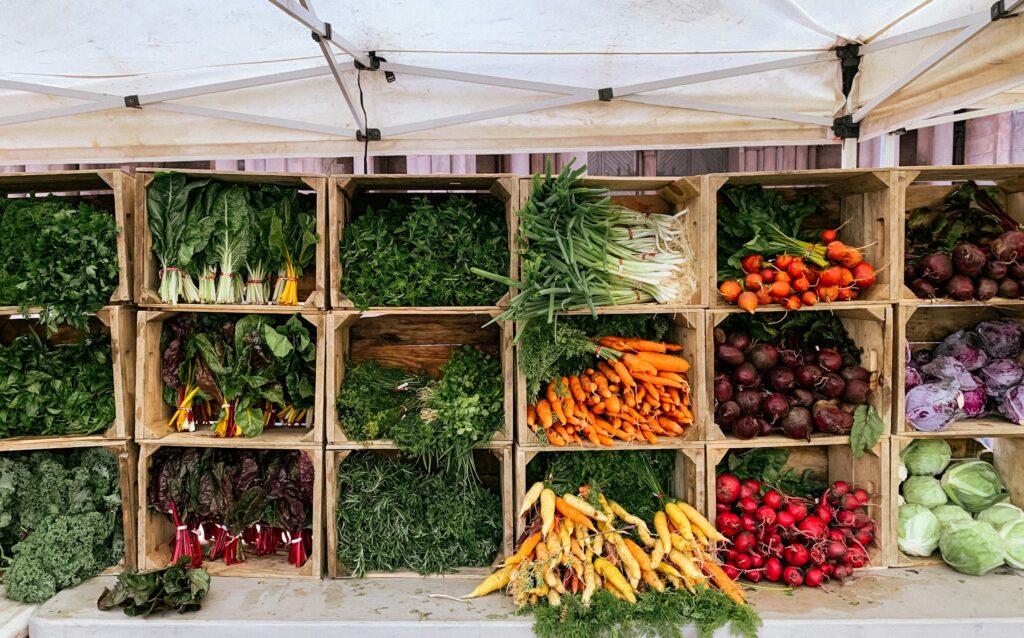
Most visitors to Split eat well without ever seeing where the food comes from. Locals do it differently. Every morning two markets, a few minutes apart, feed the whole old town — the Pazar, where the land arrives, and the Peškarija, where the sea does. No supermarket in Split can compete, and honestly, neither can most cities.
The Pazar — Split’s open-air pantry
Just east of Diocletian’s Palace, past the Silver Gate, the Pazar (locals say “pijaca”) spreads across an open square under a sprawl of striped umbrellas. It is the largest open-air market in the city and it has been trading on this spot for well over a century. Tables sag under tomatoes still warm from the field, crates of cherries and apricots, bundles of Swiss chard, jars of honey and olive oil, hand-knitted socks, and buckets of flowers. Most of the sellers are growers themselves — small family farms from the fields around Solin, Kaštela and the Sinj valley — so the produce is local, seasonal, and often picked the day before.
The Peškarija — the fish market with no flies
A five-minute walk west, tucked just off Marmontova Street, is the Peškarija — Split’s fish market, housed since 1890 in an elegant pavilion with wrought iron and Art Nouveau details. The catch is laid out on marble slabs by eight in the morning: silver sardines and anchovies (the famous plava riba, oily fish), sea bream, squid, mussels, the occasional lobster. Look up and you will notice something missing — there are no flies. The local explanation is that the market was built beside the old sulphur springs, and the faint mineral tang in the air keeps the insects away. Sulphur or simply constant scrubbing, it remains one of the only open fish markets in Europe where you will never swat once.
What’s in season right now
Markets reward you for showing up when the season does. In June that means:
- Cherries and apricots at their peak, with the first figs arriving later in the month
- Field tomatoes, peppers, courgettes, new potatoes and young garlic
- Blitva (Swiss chard) — the green that turns up beside every grilled fish
- Oily fish — sardines and anchovies — cheap, fresh, and exactly what locals grill at home
How to shop like a local
- Bring cash, in small notes. Most stalls don’t take cards, and small change makes everything smoother.
- Don’t squeeze the fruit. Point, ask, and let the seller choose — they will often hand you the ripest one to taste.
- Go early. The best of the catch and the produce is gone by mid-morning; before nine is ideal.
- Prices are per kilo (“po kili”). A little Croatian — dobar dan and hvala — goes a long way.
When and where
The Pazar runs every morning, busiest from around 7 until noon, just outside the Silver Gate of the Palace. The Peškarija opens early too and is liveliest before ten; it winds down on Sunday afternoons, so plan a morning visit. Both are free to wander even if you only come to look — and the colour alone is worth the walk.
Right outside your door
One of the quiet luxuries of staying in the old town is that this becomes your corner shop. Our apartments at Ćiril-Metodova 36, in Split’s Veli Varoš quarter, are a few minutes’ walk from both markets — close enough to carry home a bag of cherries and a fish for the grill before the day even warms up. It is the easiest way to eat like a local: skip the restaurant once, and cook what Split was cooking this morning.