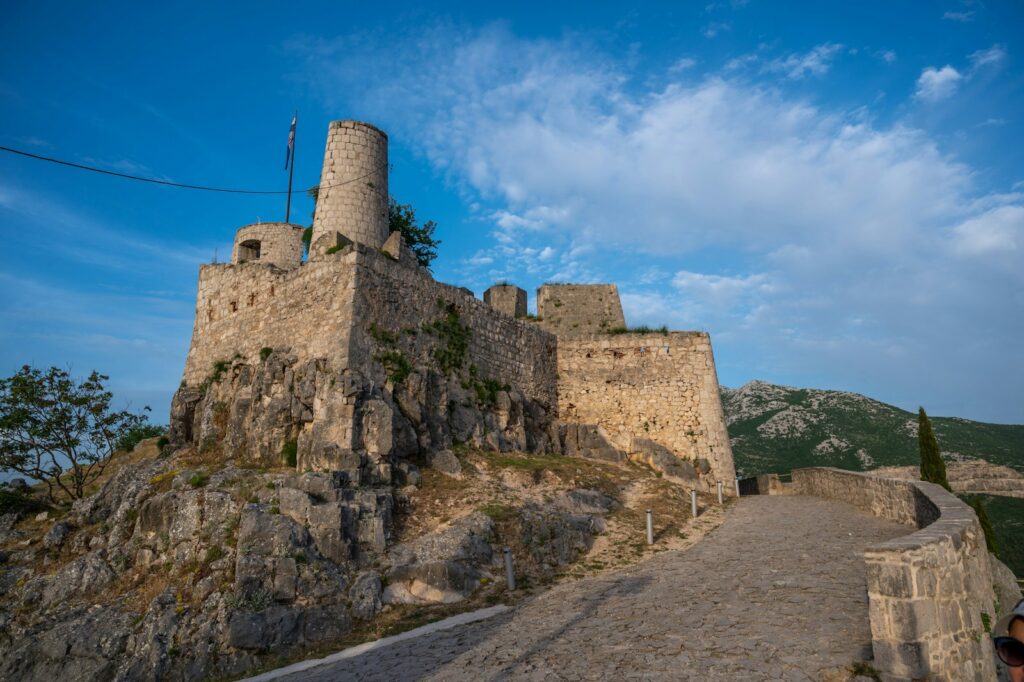
Klis Fortress sits eight kilometres north of Split’s old town, perched on a rocky saddle between two mountains, three hundred and sixty metres above the Adriatic. From its walls you can see Split, Solin, the islands of Brač and Šolta, the high ridge of Mosor, and most of Roman Dalmatia in one slow turn. It’s the best half-day trip from Split that almost no cruise passenger ever gets to.
The view, first
Walk to the highest point of the fortress and stop. To the south, Split’s red-roofed old town is a clear miniature; the Adriatic opens beyond it. To the north and east, the karst landscape of inland Dalmatia — bare limestone ridges, sparse cypresses, a few church towers in distant villages. On a clear day, you can pick out the outline of Hvar’s east end. There’s no other accessible spot near Split that gives you Roman and medieval Dalmatia in one frame. Bring water; the wind up there is usually stiff.
Two thousand years of layered history
Klis is older than most of what tourists see in Croatia. The Illyrians had a settlement here before the Romans arrived; the Romans then built a watch-fort guarding the pass to Salona. In the seventh century it became one of the seats of the early Croatian kings — Trpimir, Mislav, Zvonimir signed documents from here. In 1242 the Mongol horde got this far and was turned back. In 1537 the Ottomans took it after a heroic siege; for the next 111 years it was the westernmost Ottoman outpost in Europe, controlling the road between Split and Bosnia. Venice finally retook it in 1648. Each era left walls. The fortress you walk through is a layered palimpsest.
Yes, Game of Thrones
Klis was Meereen in seasons four through six. The walls where Daenerys hung the masters, the gates where the Unsullied marched in. It’s part of the fortress’s modern fame. Mention it once, then look up at the actual nine-hundred-year-old Croatian masonry instead. The show used Klis for two weeks; the Croatians used it for two millennia.
How to get there
- Bus: Cetinka bus from Split’s main bus station to Klis-Megdan stop, then a 5-minute uphill walk. ~30 minutes, runs roughly hourly.
- Car: 15 minutes from central Split. Parking at the foot of the fortress.
- Taxi/Uber: €15–€20 one-way from Split’s old town.
Entry to the fortress is around €10. Open daily 9am–7pm in summer, shorter hours October–April.
What to actually do up there
Allow ninety minutes to two hours. Walk all three levels — lower bailey, middle courtyard, upper terrace. Read the small Croatian-language exhibition in the converted chapel (there’s an English translation panel at the entrance). Climb to the highest tower for the view. If you’re patient, sit on a wall and watch a thunderstorm come in from the inland mountains; it’s one of the most dramatic places to see Dalmatian weather.
Pair it with lunch in Klis village
The village of Klis sits just below the fortress and is locally famous for one thing: spit-roasted lamb (janjetina s ražnja). Several family konobas line the main road through the village, and the smell of roasting lamb is unmistakable from a hundred metres away. Lunch is straightforward, slow, and excellent. Pair it with a glass of the local red, and you’ve turned a sightseeing stop into the day’s main event. (This is also vendima country in autumn — Klis village wineries pour during harvest.)
Where to stay
Klis is a half-day from any base in Split, but it pairs particularly well with our Solin apartment — same direction out of town, ten minutes by car between the fortress and your front door. Our apartments in Split’s old town work equally well; the Klis bus stop is two minutes from Diocletian’s Palace.
If you only do one half-day trip outside Split, this is the one we’d pick. Then you’ll understand why every empire that ever held Dalmatia put their flag on this hill.