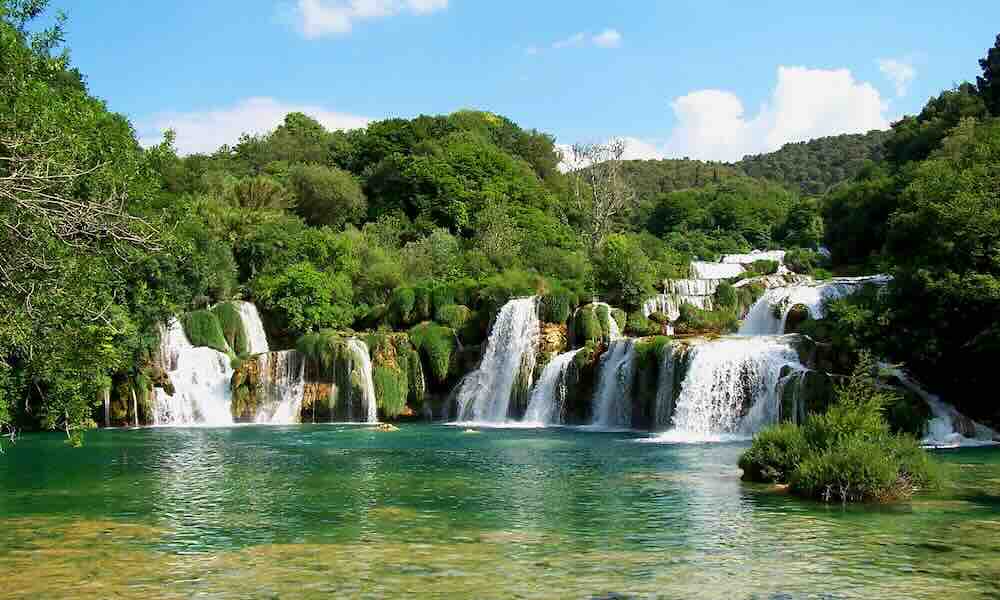
Plitvice Lakes gets the postcards. Krka National Park gets the locals.
If you’re staying in Split and trying to fit one Croatian waterfall day into your trip, Krka is almost always the right call. It’s an hour up the road instead of three, the entrance is half the price of Plitvice in shoulder season, and the cascades — while smaller — are arguably more beautiful: a wide travertine staircase the colour of weak tea, framed by old watermills and footbridges that put you right at water level. Here’s how to do it without burning a whole day in transit.
Why Krka beats Plitvice for a Split day trip
The Plitvice Lakes are spectacular, but they’re 270 km from Split — six hours of return driving for a place where the trails are crowded and rope barriers keep you well back from the water. Krka is 90 km away, roughly a 60-minute drive on the A1 motorway, and the main entrance at Skradinski buk is in a wide travertine bowl with wooden walkways that loop right over the falls.
Adult tickets at Krka in high season run about €40, but in the shoulder months — April, May, October — the price drops to around €15. Coming from Split, the difference in driving time alone changes the whole day. You can be back at your apartment for sunset on the Riva.
Skradinski buk vs Roški slap
Krka has two main waterfall complexes. Skradinski buk is the one in every photograph — the 17-tier cascade that runs from a flooded canyon down toward the village of Skradin. This is where most day-trippers stop, and rightly so: the wooden boardwalk loop takes a relaxed 90 minutes to walk, weaving past mills, an ethnographic exhibit, and roughly twenty viewpoints over the falls.
Roški slap is upstream and quieter. Smaller falls, fewer visitors, and an old hydroelectric station you can wander through. If you have time and a car, drive between the two via the village of Skradin (charming harbour, good lunch spots). A boat from Skradinski buk also leaves for the river island of Visovac, a medieval Franciscan monastery still inhabited today.
A note on swimming
This part surprises a lot of visitors: swimming at Skradinski buk has been banned since 2021. Park authorities cite ecological pressure, and they’re strict about it. If you’re set on swimming in clear river water, you’ll want to bring swimsuits to the Cetina river or any of the Split beaches instead. Krka is now for looking, not for splashing.
How to get there from Split
- By car: Fastest. A1 motorway north, exit Skradin or Drniš, follow signs. 60–75 minutes one way. Park at Skradin (free shuttle bus to the boardwalk entrance during peak season; €7 boat in shoulder months).
- Guided tour from Split: Numerous half-day options from €40–70 with hotel pickup. Solid choice if you don’t want to drive and don’t mind a group pace.
- Public bus: Possible but slow and inflexible. Bus to Šibenik (1h 45m), then connection to Skradin. Doable for the determined, painful otherwise.
When to go
Late May through mid-June and all of September are the sweet spots: water levels are still healthy, mid-day temperatures are kind, and the boardwalk doesn’t feel like a queue. July and August are crowded, especially between 11am and 3pm when cruise excursions arrive — go early (gates open at 8am in summer) or after 3pm. April and October are quieter still but bring a light jacket: spray from the falls is cold.
What to bring
- Walking shoes with grip — the boardwalk gets wet near the falls.
- A light rain shell if visiting in shoulder season.
- Water and snacks (the park sells food but at park prices).
- Cash for small village restaurants in Skradin if you’re stopping for lunch.
From Sika Apartments
Most of our guests staying at Apartment Sika Split in the old town do Krka as a day trip out and back, leaving around 9am and returning in time for a 7pm konoba dinner. Guests at Apartment Sika Solin have a small head start — already on the highway north — so it’s a particularly easy add to a Salona-and-Krka same-day combination if you like packing two ruins-and-water sites into one outing.
Either way, you’ll come back with photos that look nothing like the Adriatic blue, and a sense that you’ve seen the inland side of Croatia most beach-day travelers miss.