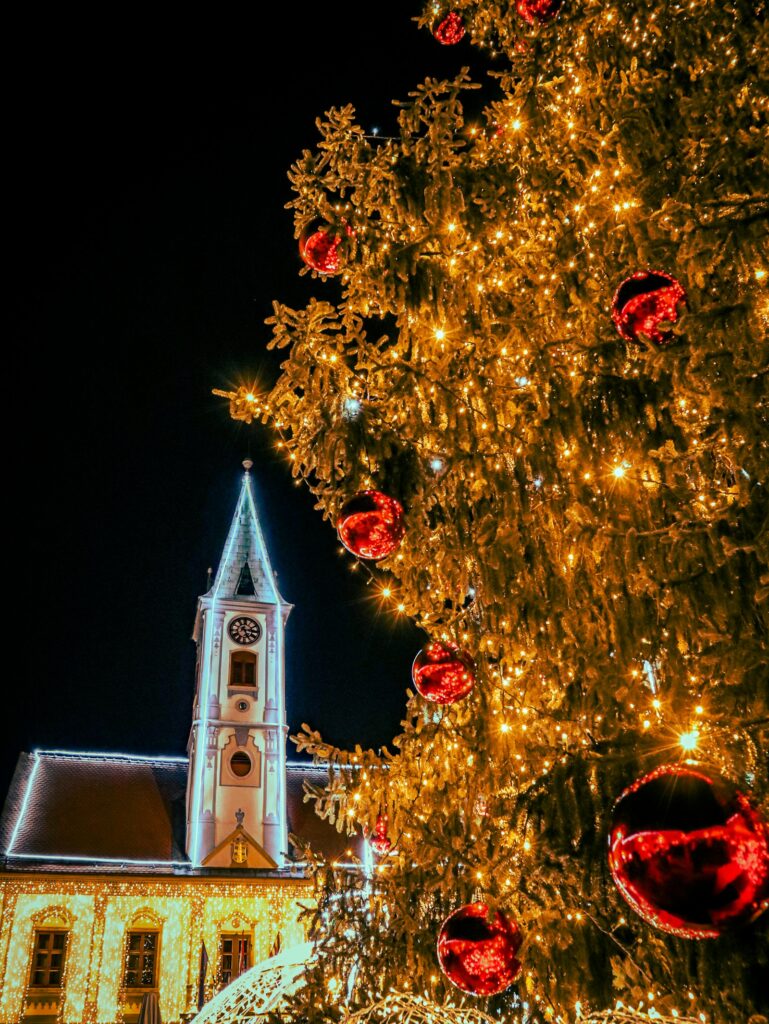
Mid-December in Split looks almost nothing like the postcards. The cruise ships are gone. The Riva belongs again to old men with newspapers, kids in puffer jackets, and a row of small wooden chalets dressed for Advent. Diocletian’s Palace, drained of its summer crowds, becomes what it actually is: a Roman emperor’s retirement villa, with locals walking dogs through its corridors. This is Split’s quietest, warmest season — a half-known way to see Croatia.
Why Split in winter is underrated
European December sells two stories: snow-laden alpine markets in Vienna or Strasbourg, or sun-soaked escapes to the Canaries. Split sits in a third category most travelers miss entirely. The climate stays mild — usually 8–12°C on a winter day, sometimes warmer — the historic core is walkable in thirty minutes, and you’ll share Peristyle square with maybe ten people instead of three thousand. Prices on apartment stays drop by more than half versus July.
Advent in Split: where the markets are
Split’s Advent runs from the last weekend of November through early January. Three main clusters worth walking between:
- Riva (waterfront) — the largest. Rows of wooden chalets selling fritule (small Croatian doughnuts), kuhano vino (mulled wine), grilled sausages, handmade ornaments. Free concerts most evenings, particularly on weekends.
- Prokurative (Republic Square) — smaller, more local. Choirs, traditional klapa singing, the city Christmas tree.
- Pjaca (People’s Square) — quieter still. A handful of stalls, popular with families.
Don’t expect Vienna-scale grandeur. Split’s Advent is intimate, folksy, sometimes a little improvised — but it’s also a few feet from the sea, which no Alpine market can match.
The weather you can actually expect
This is the part that surprises most first-time winter visitors. Split’s average December high is around 12°C; January and February lows can drop to 4–5°C overnight but daytime usually stays above 8°C. It rains, but rarely snows. The exception is bura — a cold northeast wind that sweeps down from the Dinaric mountains for a day or two, dropping the feels-like temperature sharply. Pack a wind layer, not necessarily a heavy coat.
You can still drink coffee on an outdoor terrace in mid-January wearing a sweater. Try doing that in Prague.
Christmas Eve, Croatian-style
December 24th in Croatia is Badnjak — a fasting evening built around fish rather than turkey or goose. The traditional dish is bakalar (salt cod), prepared either as a creamy white spread or a simple stew. Most restaurants close for family time, but a few keep the doors open and serve a Badnjak menu. Midnight Mass at Saint Domnius — the cathedral inside Diocletian’s Palace bell tower — is a uniquely Split experience: ancient Roman walls, Latin liturgy, the city outside completely still.
New Year’s Eve on the Riva
Split’s Doček is one of the largest free concerts on the Croatian coast. Two or three nights of music — typically a mix of pop, klapa and folk — culminate in fireworks over the harbor at midnight. Dress warm, bring a flask, expect crowds and good humor. The city wakes slowly on January 1st; most cafés open mid-morning.
What’s open (and what isn’t)
- Open year-round: most cafés, supermarkets, the green market (Pazar), the fish market (Peškarija), most konobas in the old town, all major museums, the Cathedral, and ferries to nearby islands on reduced schedules.
- Reduced or limited: many beach bars, some Brač/Hvar/Šolta ferry routes, Marjan hill cafés (some), Klis Fortress (winter hours, often weekends only).
- Closed for the season: tourist-trinket shops, a handful of restaurants taking a January–February break.
Local rule: anything important to locals stays open; anything aimed only at summer visitors is shut. Check ahead for specific places.
Where to stay in winter Split
A heated apartment in the old town beats a hotel for winter — kitchens for hot meals when restaurants close, more space to spread out gear, and no crowded breakfast rooms. Our three apartments at Ćiril-Metodova 36 are minutes from the Riva markets and Diocletian’s Palace; the Solin apartment near Salona gives you a quieter, greener winter base ten minutes from the city.
Winter is when Split shows its real character — fewer photos, more memory.