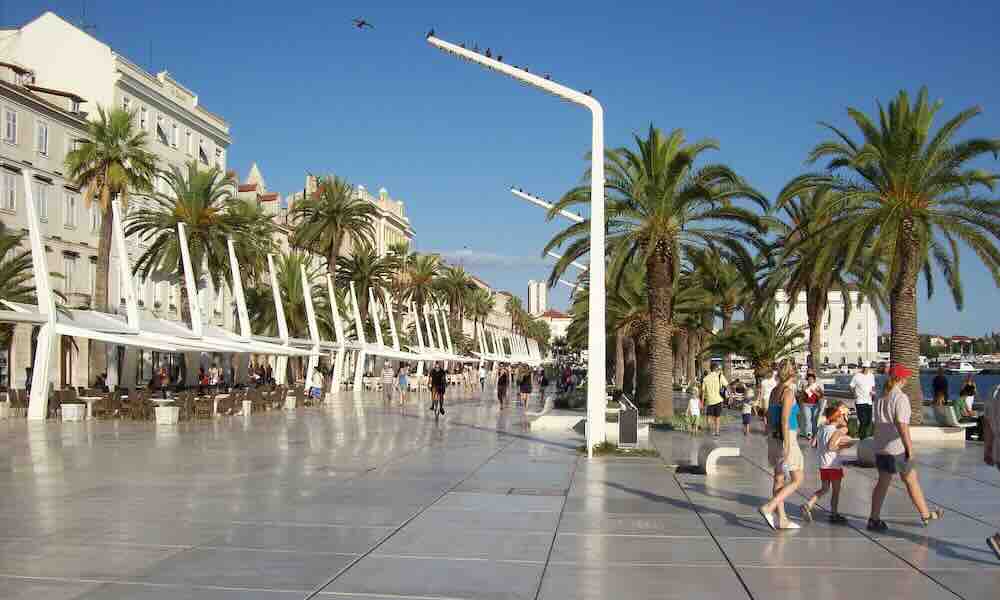
July and August in Split are loud, hot, and expensive. The Riva fills with cruise-ship day-trippers, the Old Town becomes a moving wall of people, and a coffee on the seafront can cost twice what it costs in May. The locals know this. Most of them quietly leave.
If you have any flexibility in when you travel, shoulder season — late spring and early autumn — is the right answer. Here’s what May, September, and October each give you, and what to expect when you get here.
Why peak summer isn’t actually the best time to visit Split
The temperatures top 35°C, the air is humid, the stone of Diocletian’s Palace radiates heat through the night. Restaurants are full, ferries to the islands sell out, parking near the old town turns into a sport. The city is at its most international and at its least like itself. None of this is a tragedy, but if you’re paying for the privilege, you can do better.
May — when Split exhales
By the second half of May the air settles at 22–25°C, the sea sits around 19–21°C — a little brisk on the first dive, fine after that — and the city is awake but not packed. The Riva’s bars open until late, the konobas have terrace tables again, and you can walk the Peristyle in the morning without dodging anyone. Almonds and the first figs start showing up at the Pazar — the open market behind the palace. It’s a working city in spring, with tourists added.
September — the locals’ favourite
Split locals will quietly tell you September is the best month of the year, and they’re right. The sea is at its warmest — 24–25°C — the air still 25–28°C in daytime, and by mid-month the cruise season starts winding down. Restaurants stay open, ferries run their full schedules, and the islands feel almost private compared to August. If you go to Hvar, Brač, or Šolta in September, you’ll see what those islands look like when locals run them.
October — soft summer, empty beaches
Early October is still summer in everything that matters: 22–25°C in the sun, sea around 22°C, cafés open late, a long warm light that flatters every limestone wall in town. By mid-October it cools — evenings need a sweater — but the daytime stays warm into the third week. The big change is the streets. The Old Town empties. Konobas put a few tables outside in the sun and the whole city tilts back to slower rhythms. A late-October week in Split is one of the year’s quiet pleasures.
What’s open, what isn’t
In May and September almost everything operates on its full summer schedule. By late October some seasonal restaurants and beach bars start closing for the year, but the core of the city — the konobas in Varoš, the Pazar, the major sights, ferries, transport — runs all year. Don’t worry about the city shutting down. Worry instead about choosing among too many options.
A few practical things
Apartments and hotels charge less in shoulder season. May and October pricing is roughly 25–40% below August. Flight fares to Split airport drop in step. The sea is swimmable May through October — locals routinely swim into November, but you might want a wetsuit by then. Pack a light layer for the evenings even in May, since the bura wind from the mountains can make it surprisingly cool after sunset.
One catch: Easter and ferry schedules
If you’re coming around Easter (which falls in March or April), most of Croatia stays partly closed until May 1st (Labour Day). Some restaurants open earlier, some don’t. Ferry schedules to the smaller islands run reduced winter timetables until late May. From mid-May onwards everything is open. From mid-October onwards islands like Šolta or Vis return to a quieter, less frequent ferry rhythm — still operational, just less convenient for a quick day trip.
If you want the city without the crowd — with a stone-walled apartment and a five-minute walk to the harbour — we have a few of those. Most of them are easier to book in shoulder season than in August.