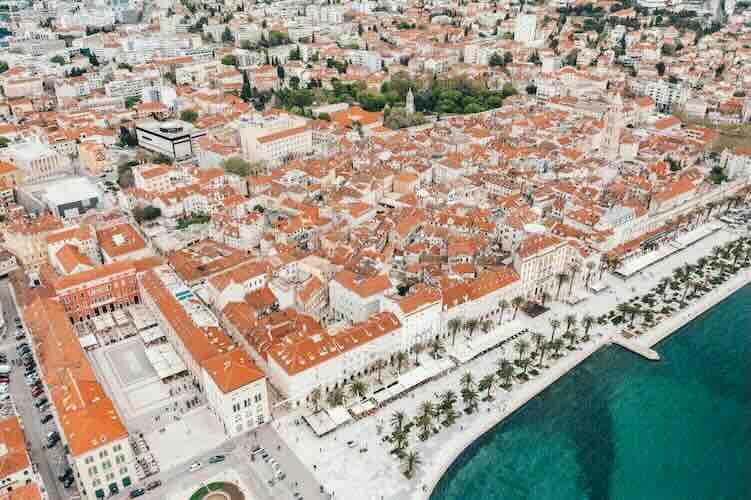
Diocletian’s Palace is the reason most travellers fall hard for Split. It is not a museum behind ropes — it is a 1,700-year-old Roman palace that became a living town, with apartments, cafés, a cathedral and a 200-strong fish market all woven into the original imperial walls. Here is how we help our guests at Sika Apartments get the most out of it, beyond the obvious selfie spots.
A 60-second history
Emperor Diocletian retired here in AD 305 — the only Roman emperor who voluntarily stepped down. He built a palace that was half fortified residence, half military camp. After the empire fell, locals from nearby Salona moved in to escape invasion, and the palace has been continuously inhabited ever since. That is why you will see Roman columns supporting medieval shops and Renaissance windows cut into 4th-century walls. UNESCO listed the entire historic core in 1979.
The four gates and which one to use
- Golden Gate (Porta Aurea, north) — the original main entrance, framed by the famous Gregory of Nin statue (rub his big toe for good luck — locals do). Best for first arrivals.
- Bronze Gate (south, on the Riva) — opens into the atmospheric cellars (Podrumi). The fastest route from a sunset Riva walk into the heart of the palace.
- Iron Gate (west) — leads onto Pjaca, Split’s liveliest square. Good for cafés and people-watching.
- Silver Gate (east) — opens onto the Green Market (Pazar). Use this for the freshest fruit you have eaten all year.
Five spots most visitors miss
- The vestibule — circular hall just above the cellars. Klapa singers often perform here; the acoustics make goosebumps. Free to enter.
- Cathedral of Saint Domnius bell tower — the climb is steep and not for the seriously claustrophobic, but the rooftop view over the palace is the best in town. Around 7 €.
- Jupiter’s Temple (now baptistry) — tiny, easy to miss in a side alley, but the original sculpted ceiling is breathtaking.
- Substructures of the imperial apartments (Podrumi) — yes, the “Game of Thrones dragon den”. Ticket office near the Bronze Gate.
- Quiet courtyards behind the Peristyle — turn into any unmarked alley after 9 pm and the crowds vanish.
When to visit (without the crowds)
Cruise ships unload between roughly 09:30 and 13:30, and again 16:00–19:00 in high season. Split’s palace is very small for the amount of traffic it gets in July and August, so timing matters more than the season:
- Best — early morning (before 09:00) or after 20:00. The light is better and you actually see stones, not heads.
- Worst — Saturday late morning in July/August.
- Hidden best — light rain in shoulder season. The palace shines under wet limestone.
Why we recommend staying inside (or right next to) the walls
The single biggest difference for travellers is being able to step outside, walk five minutes through stone alleys, and be at Pjaca for morning coffee. Three of our four apartments — Sika Split, Dujka’s Balatura and Baštun — sit on Ćiril-Metodova 36, a short flat walk from Pjaca and the Riva. You hear no traffic at night, just the bells of the cathedral.
If you prefer a quieter base with the palace as a 15-minute drive away, our Sika Solin apartment sits next to the older Roman ruins of Salona — Diocletian’s actual hometown.
Practical info
- Walking around the palace exterior and Peristyle is free, 24/7.
- Cathedral of Saint Domnius and the bell tower: around 5–7 € depending on the combo ticket.
- Substructures (Podrumi): around 7 €.
- Tour guides are easy to book on the spot, but the small private guides (Klesarska škola, Toby Tours) are far better than the big group flag-following ones.
- Wear comfortable shoes — the streets are polished marble and become a skating rink after rain.
Have a question about the palace, opening hours, or what to do nearby? Get in touch — we are happy to help you plan around the cruise crowds and the August heat.